
Research
Actionable Insight Reports on the supply networks behind trade policy, critical inputs and technology. Each one is published with its data sources, methods and limits, newest first.
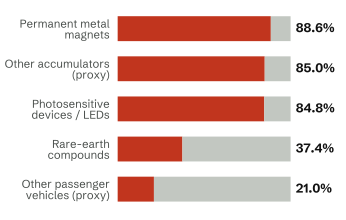
China supplies 88.6 percent of the EU's external magnet imports
Concentrated Chinese input supply and European export exposure create different pressures. AIR 005 maps the trade, legal measures and production-cost channels that matter for sourcing and sales decisions.
China share of EU external imports, 2024, percent
-
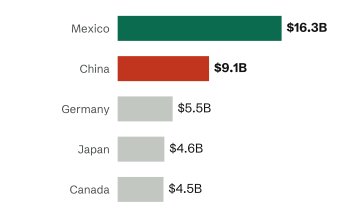
Mexico now supplies 1.8 times as much U.S. physical-AI hardware as China
China's share of the $72.5 billion trade in robot, sensor, control and motor hardware has more than halved since 2010, and half of the trade sits in controls and power.
U.S. imports by origin, five largest, 2024, US dollars
-
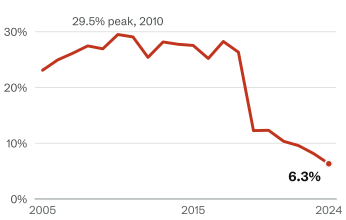
China's share of U.S. AI-compute hardware imports has fallen to 6.3 percent
It peaked at 29.5 percent in 2010 and halved after 2018. Mexico and “Other Asia, n.e.s.” (commonly Taiwan) now supply half of the $164.5 billion trade.
China-origin share of U.S. imports, 2005–2024
-
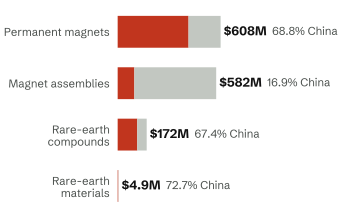
China supplies 68.8 percent of U.S. permanent-magnet imports
Across all rare-earth focus products, China's share has more than doubled since 2005, to 46.6 percent, the opposite of the trend in technology hardware.
U.S. rare-earth imports by product group, 2024, US dollars; red is the China-origin part
-
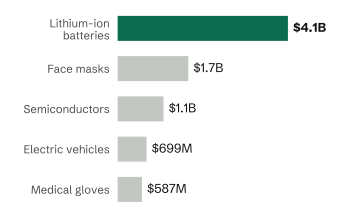
New Section 301 tariffs put a $8.8 billion duty base on 52 strategic products
Lithium-ion batteries carry 46.5 percent of that duty base, and China's share of these strategic products has fallen more slowly than its share of everything else.
Gross scheduled duty base by tariff product group, US dollars
Every figure in these reports can be explored by product family in the Data explorer.