
Look beyond industrial robots.
Cameras, navigation devices, sensors, controls, converters, and motors determine whether the system can perceive, decide, and move.
Actionable Insight Report 004
A compact screen for robots, vision systems, navigation hardware, sensors, control boards, power electronics, and motors that support physical-AI deployment.
Client decision supported
Cameras, navigation devices, sensors, controls, converters, and motors determine whether the system can perceive, decide, and move.
Alternative origins matter only after qualification, safety requirements, firmware, calibration, and customer approvals are considered.
The next diligence step is a BOM and spares register organized by perceive, decide, control, move, and power functions.
Visual evidence in the report
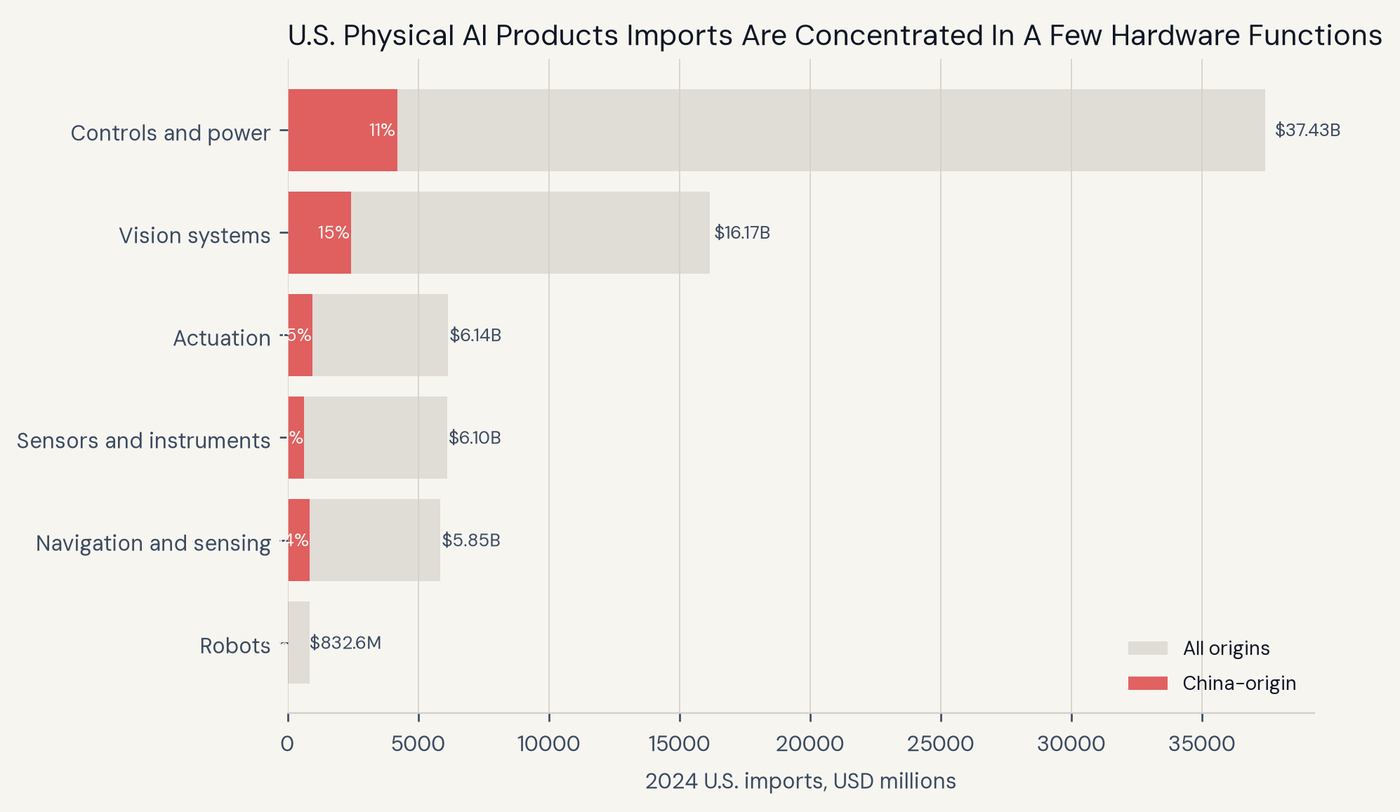 Trade exposure
Bars split U.S. platform imports and China-origin exposure across controls, power, sensors, robots, and actuation.
Swipe horizontally on mobile to inspect the full figure.
Which hardware functions dominate import value. Bars split U.S. platform imports and China-origin exposure across controls, power, sensors, robots, and actuation. Source: CEPII BACI HS02 V202601; OECD ICIO 2023 edition (2020 table). Analysts’ calculations.
 Time trend
The trend chart shows total U.S. import scale and China-origin share without a misleading dual axis.
Swipe horizontally on mobile to inspect the full figure.
Platform growth is separated from China share. The trend chart shows total U.S. import scale and China-origin share without a misleading dual axis. Source: CEPII BACI HS02 V202601; OECD ICIO 2023 edition (2020 table). Analysts’ calculations.
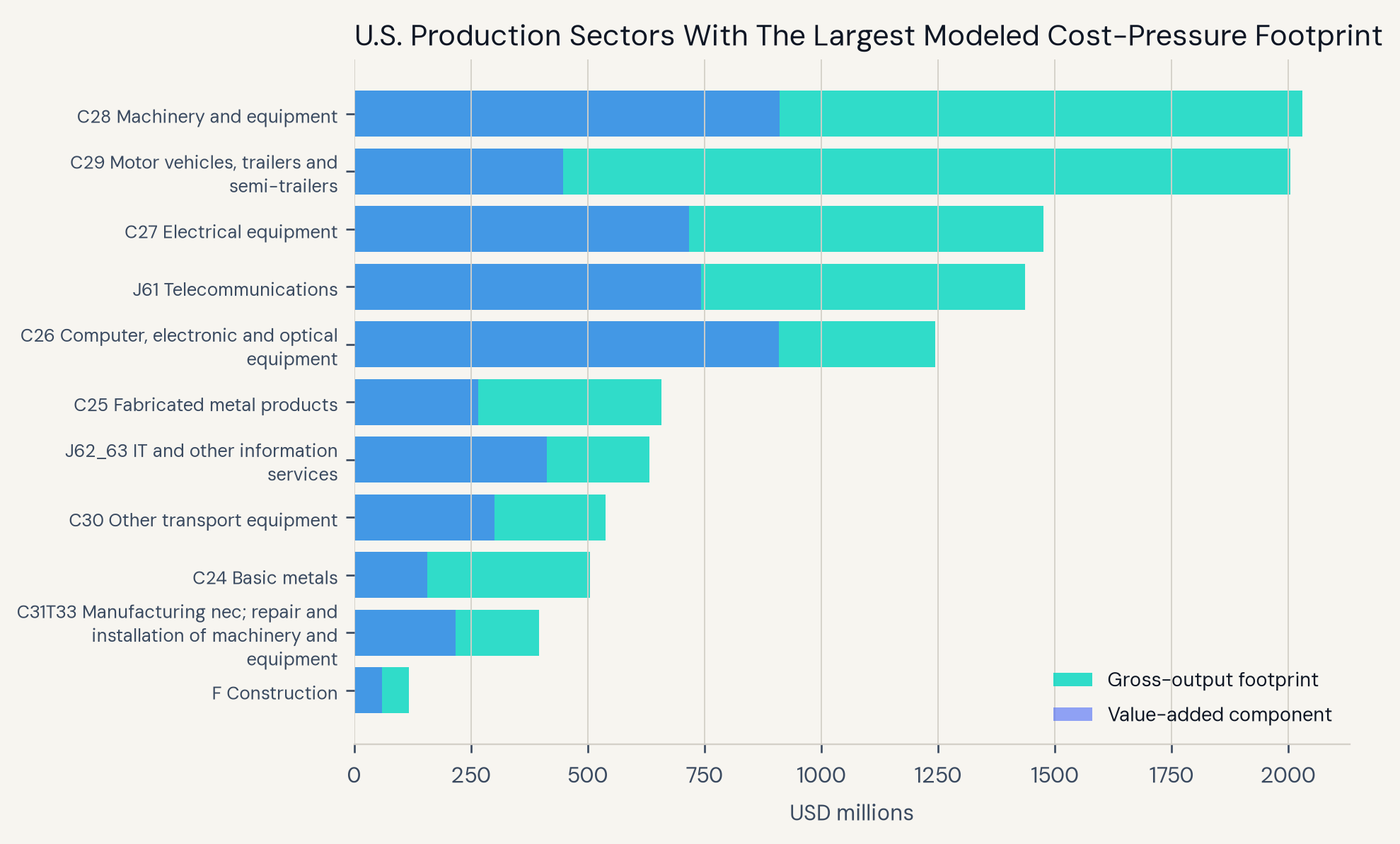 IO footprint
The ICIO screen maps direct China-origin hardware exposure to downstream U.S. production sectors.
Swipe horizontally on mobile to inspect the full figure.
Which sectors may feel cost-pressure incidence. The ICIO screen maps direct China-origin hardware exposure to downstream U.S. production sectors. Source: CEPII BACI HS02 V202601; OECD ICIO 2023 edition (2020 table). Analysts’ calculations.
Source: CEPII BACI HS02 V202601; OECD ICIO 2023 edition (2020 table). Analysts’ calculations.
These figures are public-data screening tools for identifying products, sectors, and network nodes that warrant further diligence. They are not company-level bills of materials, qualified-supplier lists, tariff rulings, or causal forecasts; definitions, assumptions, reference years, and sources should be read with the report.
Read the full method and definitions in the PDFHow to use it
The report is designed for robotics deployment, advanced manufacturing, logistics automation, procurement, and investor teams that need to separate an AI narrative from the hardware supply platform that must be qualified and maintained.
Translate the HS6 screen into a deployment-level bill of materials with safety-critical parts, qualified suppliers, spare-parts exposure, firmware/calibration dependencies, and acceptable alternative origins.